
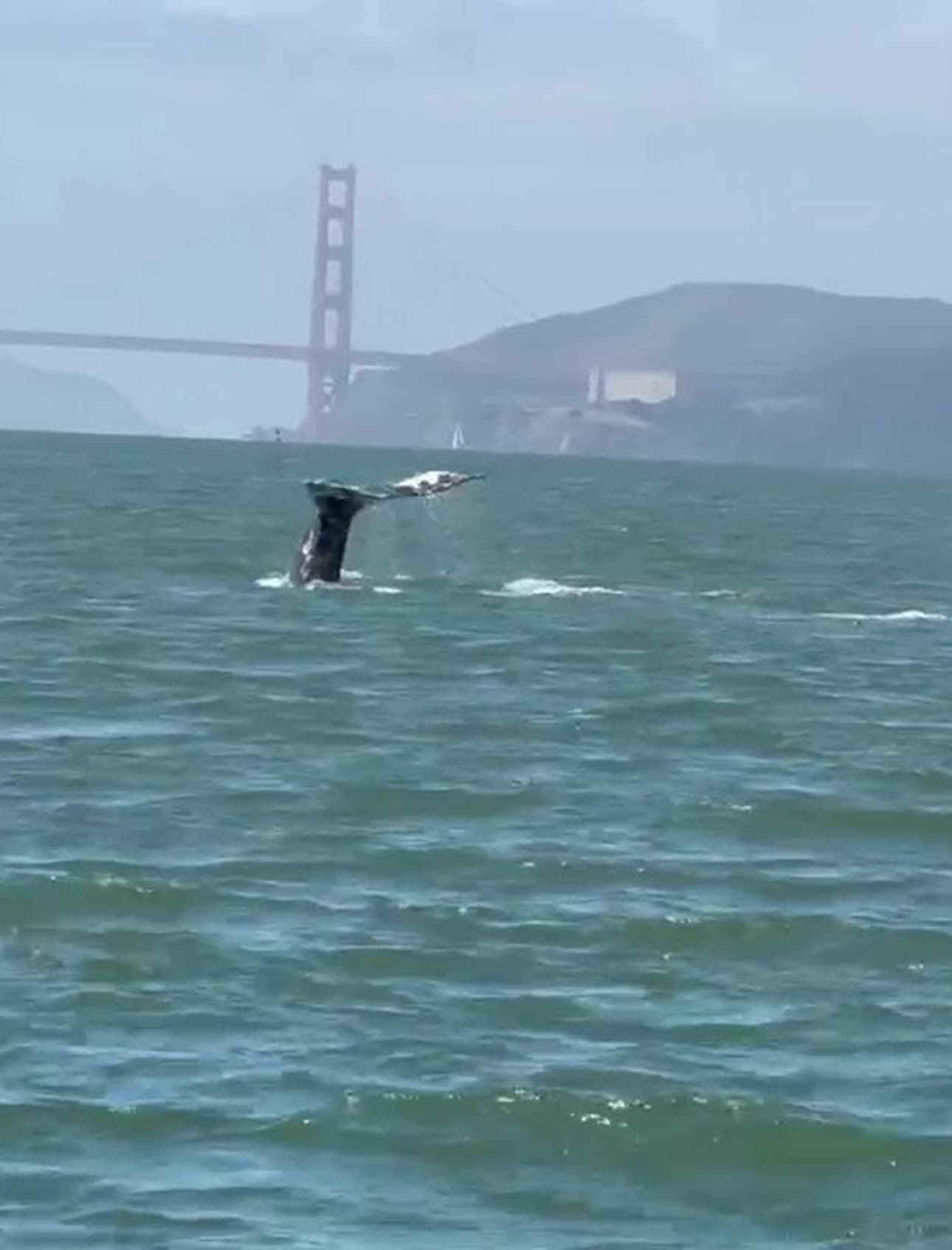
Whale watching in San Francisco runs most of the year, in two overlapping seasons. Gray whales pass the coast on migration from December into June, and some swim inside San Francisco Bay, mostly from February to June. Humpback and blue whales feed offshore from March through November, with March to August the prime months. Humpbacks are around nearly year-round.
Whale season in San Francisco, month by month
| Month | Gray whales | Humpback and blue whales | Also at the Farallon Islands |
|---|---|---|---|
| January | Southbound migration along the coast | Humpbacks present in smaller numbers | Elephant seal breeding |
| February | Southbound ends, northbound begins mid-month, and grays start entering the Bay | Humpbacks present in smaller numbers | Elephant seal breeding |
| March | Northbound peak, grays inside the Bay | Prime season begins | Seabird nesting begins |
| April | Northbound peak, mothers and calves pass, grays inside the Bay | Prime season | Seabird nesting |
| May | Last mothers and calves in early May, grays inside the Bay | Prime season | Seabird nesting |
| June | Last northbound whales, grays inside the Bay | Prime season | Seabird nesting |
| July | Rare | Prime season | Seabird nesting |
| August | Rare | Prime season | Seabird nesting winds down |
| September | Rare | Good season | White sharks |
| October | Rare | Good season | White sharks |
| November | Rare | Good season | White sharks |
| December | Southbound migration begins | Humpbacks present in smaller numbers | Elephant seal breeding |
Sources: Greater Farallones National Marine Sanctuary, Seasons of the Sea; The Marine Mammal Center, how to see the gray whale migration; and a 2026 study of gray whales in San Francisco Bay (Frontiers in Marine Science). Wildlife is never guaranteed in any month.
When is whale watching season in San Francisco?
There are two seasons, and they overlap in spring.
March to November: humpbacks and blue whales. The Greater Farallones sanctuary describes March through August as “prime time for humpbacks and blue whales” and September through November as “a great time” for both. The sanctuary also notes that whales are present nearly year-round, particularly humpbacks.
December to June: gray whales. Gray whales migrate along the California coast, and San Francisco is on the route. The southbound leg passes in winter, and the northbound leg runs from mid-February into June.
The best month depends on which whales you want to see.
Gray whale migration along California
- Southbound: December to February, according to the Greater Farallones sanctuary. The Marine Mammal Center puts the southbound passage past California in December and January.
- Northbound: mid-February to early May, mostly March and April (The Marine Mammal Center). The sanctuary counts northbound grays passing through June.
- Mothers and calves come last, in April into early May.
Some gray whales leave the migration and come in through the Golden Gate. A 2026 study in Frontiers in Marine Science surveyed gray whales inside San Francisco Bay from February to June each year. The researchers identified 114 individual whales from 2018 to 2025, and 36 whales entered the Bay in 2025. At least 18% of the whales identified died. Out-of-season sightings in the Bay are rare: the study notes only August 2021 and December 2024.
Two programs work to keep ships from striking whales off San Francisco. Whale Safe, run by UC Santa Barbara’s Benioff Ocean Science Lab with The Marine Mammal Center and Point Blue, alerts ships to blue, fin and humpback whales. Protecting Blue Whales and Blue Skies is a voluntary 10-knot speed program for ships.
Are there whales in San Francisco Bay?
Yes. Gray whales come inside the Bay, mostly between February and June. Humpbacks feed off the coast from spring through fall and sometimes come in through the Golden Gate. On any given day the whales may be in the Bay or out in the Pacific, which is why a whale trip’s route depends on recent sightings.
When gray whales come into the Bay
Gray whales pass San Francisco twice a year. They head south from December to February and north from mid-February into June, mostly in March and April, with mothers and calves last, in April into early May (Greater Farallones National Marine Sanctuary; The Marine Mammal Center). Some of them leave the migration and swim in through the Golden Gate.
A 2026 study in Frontiers in Marine Science surveyed gray whales inside the Bay from February to June each year:
- 114 individual whales were identified from 2018 to 2025.
- 36 whales entered the Bay in 2025.
- At least 18% of the whales identified died.
- Out-of-season sightings were rare: August 2021 and December 2024.
In 2026 the first gray whale inside the Bay was reported on January 21, ahead of the usual February start.
Humpbacks and blue whales
Humpback and blue whales feed off San Francisco from March through November. The Greater Farallones sanctuary names March to August as the prime months and notes that humpbacks are present nearly year-round. Blue whales stay offshore. Humpbacks are the ones that sometimes come inside the Gate.
Why the Farallon Islands
The Farallon Islands sit about 30 miles west of the Golden Gate Bridge (U.S. Fish and Wildlife Service), inside the Greater Farallones National Marine Sanctuary. Humpback and blue whales feed around them from March through November. The islands also hold the largest seabird nesting colony south of Alaska, with nesting from March to August. Elephant seals breed there from December to February, and white sharks gather from September to November.
You can’t land: the islands are a National Wildlife Refuge, and the refuge is closed to the public. Getting there is a real open-ocean crossing, and conditions offshore are often nothing like the Bay. The Farallon Islands tour is a full day.
What kinds of whales can you see?
- Gray whales: December to June along the coast, and inside the Bay mostly February to June.
- Humpback whales: March to November, present nearly year-round and sometimes inside the Golden Gate.
- Blue whales: March to November, offshore.
- Orcas: Bigg’s (transient) killer whales are seen off the coast occasionally, most often in spring when gray whale calves migrate. They rarely enter the Bay. Treat this as typical, not something to count on.
How close can you get? NOAA’s 100-yard guidance
NOAA’s West Coast guidance for boaters is to stay at least 100 yards from whales. It’s guidance for avoiding harassment under the Marine Mammal Protection Act. A fixed 100-yard legal limit applies only in Hawaii and Alaska (for humpbacks) and Puget Sound (for orcas). NOAA also advises slowing to no-wake speed near whales, approaching parallel from the side and never cutting across a whale’s path. The Greater Farallones sanctuary advises 10 knots or less near whales. Captain Molly follows this guidance. Details: NOAA, Be Whale Wise.
Book a private whale watching tour
Our private whale watching tour is 3 hours aboard Miss Molly from Hyde Street Harbor at Fisherman’s Wharf, $1,050 for the whole boat, for up to 6 guests. Children count toward the 6, and there are no other passengers.
- Captain Molly follows recent sightings and plans the route with you to improve the odds: inside the Bay or out past the Golden Gate, depending on where the whales are.
- There’s no sighting guarantee. Be wary of anyone who offers one.
- For a full day offshore, the Farallon Islands tour is 8 hours, $2,800 for the whole boat.
- Recent whale photos are on Instagram at @mollys_boats.
Book online. Questions first? Use the Ask Molly button and she replies in writing within 24 hours. See all private boat tours.
What to bring
Layers, more than you think. It’s colder and windier outside the Golden Gate than on the wharf. Bring a windproof outer layer, a hat, sunglasses, and sunscreen even when it’s gray. Bring your own food and drinks.
If you get motion sick, take medicine before you leave the dock, not after you feel ill. The CDC says meclizine (Bonine) and dimenhydrinate (Dramamine) take about 2 hours to start working. Ask your doctor if you’re unsure, and see our seasickness answer.
Bring a camera with a zoom lens, and binoculars if you have them.
Frequently asked questions
When is the best time for whale watching in San Francisco?
March to August for humpback and blue whales, with good viewing into November. For gray whales, the northbound migration from mid-February to early May, mostly March and April, with mothers and calves last.
How long is a whale watching trip?
Our private whale tour is 3 hours. The Farallon Islands tour is a full day, about 8 hours.
Do you guarantee whale sightings?
No. Whales follow a seasonal migration and move between the Bay and the open Pacific. Captain Molly follows recent sightings to improve the odds.
How many people can come?
Up to 6 guests, including children.
Is it rough out there?
Offshore to the Farallones, often yes. Inside the Bay, usually less so. If Captain Molly cancels for weather, you get a full refund or a new date.
What’s the cancellation policy?
You pay in full when you book. Cancel up to 7 days before the trip for free. Within 7 days there’s no refund. If Captain Molly cancels for weather, you get a full refund or a new date.