
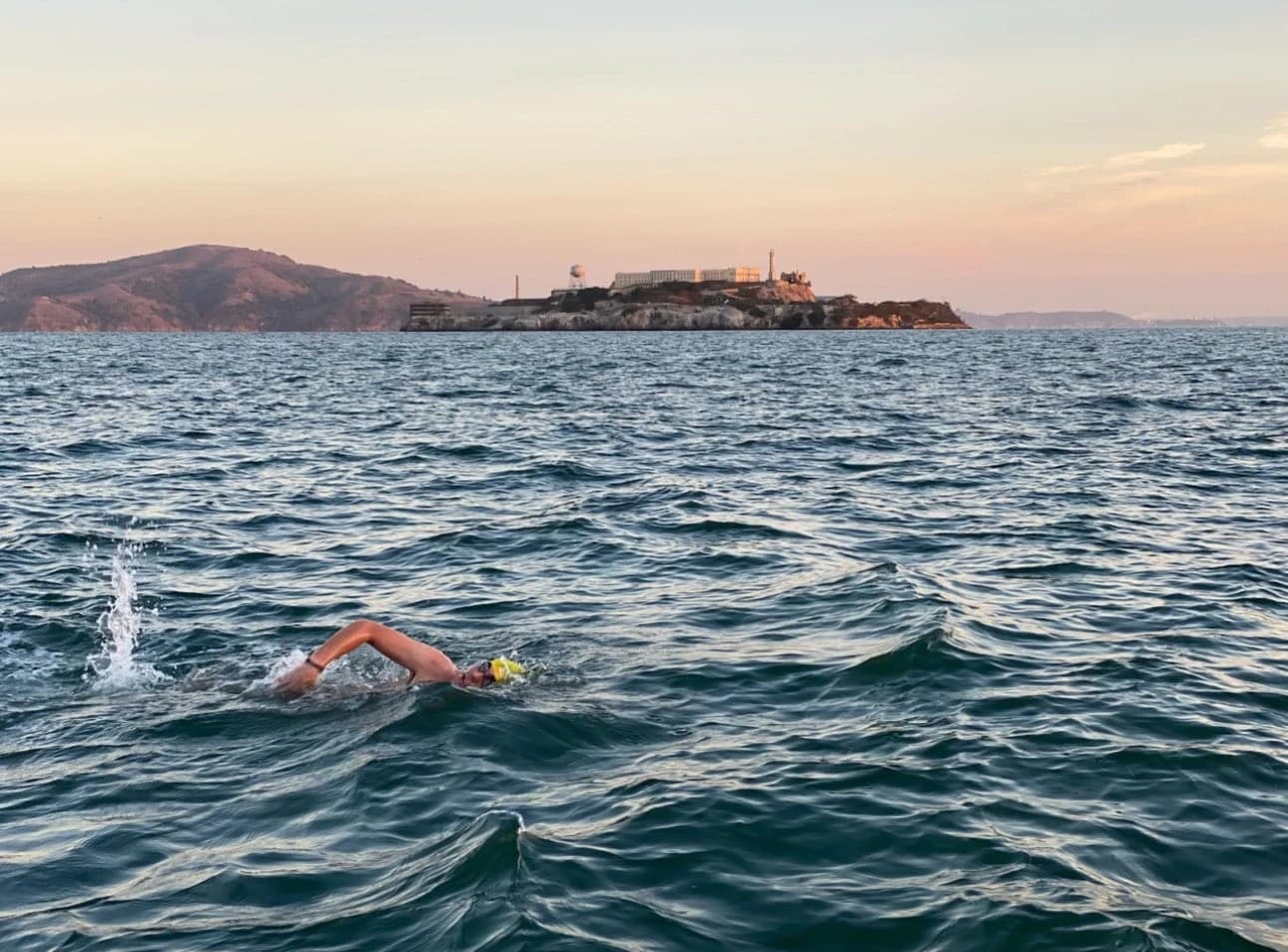
The Alcatraz swim runs about 1.5 miles from the island to San Francisco, through cold water and across the Bay’s main shipping channel. Most swimmers finish in about an hour. The cold and the current are the hard part, more than the distance, and the timing of the tide decides how the crossing goes.
| Question | Short answer |
|---|---|
| How far is the Alcatraz swim? | About 1.5 miles in a straight line to the St. Francis Yacht Club. Expect 1.7 to 1.9 miles as swum, because the current pushes you sideways. |
| How long does it take? | About an hour for most swimmers. Pace and current change that. |
| How cold is the water? | The Bay averages about 52°F in January and about 61°F in September (NOAA). |
| Are there sharks? | White sharks pass through the Bay at times, but there’s no verified white shark attack on a swimmer inside the Bay on record. |
| Can you swim it on your own? | Swimmers start from a boat beside the island, and the route crosses the shipping channel. Swim it with an escort boat. |
The route: Alcatraz to the St. Francis Yacht Club
Captain Molly runs you out from Hyde Street Harbor to Alcatraz. You get ready aboard Miss Molly, jump in near the island and swim back toward the city, finishing at the St. Francis Yacht Club in the Marina.
The straight-line distance is about 1.5 miles, but almost nobody swims a straight line. On most days the current sets across the route, so you aim up-current of the finish and let the water carry you onto it. That’s why the swum distance usually lands between 1.7 and 1.9 miles. If you aim straight at the yacht club, the current can sweep you past it.
Tides and currents: when to jump
The ebb runs out through the Golden Gate and the flood runs back in. Either one will drag you off line if you start at the wrong time. Swimmers plan around the change between the two, when the current is weakest, and pick a jump time that leaves enough slack water to finish.
Slack water is short, and it doesn’t arrive at the same moment everywhere in the Bay. A flat-looking surface also tells you nothing about the current underneath it. Wind and current are separate problems. The worst combination is wind blowing against the tide, which stacks up steep, short chop.
Molly’s jump time planner works from NOAA current predictions. Check it before you pick a date, then book the day that fits.
Cold water and wetsuits
The water is the biggest test. The National Weather Service warns that cold shock can be as dangerous in 50 to 60°F water as in much colder water, and the gasping reflex hits in the first two to three minutes. Swimmers who are strong in a heated pool get caught out by this all the time.
Wear what you normally wear for a cold-water swim, and make sure it’s broken in. Swim day is the wrong day to try a new wetsuit, cap or goggles. A wetsuit adds warmth and buoyancy. Going without one is a real option for swimmers who already train in Bay water through the year, and a bad idea for anyone who doesn’t.
Get used to cold water gradually, with other people around, in the weeks before the swim. When you jump, give your breathing a minute to settle before you put your face down and start swimming.
Sharks and other worries
“Alcatraz sharks” is one of the most common searches about this swim, so here’s the honest version. White sharks do come into San Francisco Bay at times. In 2015 tourists watched one kill a seal near Alcatraz, which researchers described as the first known predatory attack by a white shark inside the Bay. Shark Stewards, a Bay Area conservation group, says there is no verified white shark attack on a human inside the Bay.
The sharks you’re more likely to share the water with are the small local species, such as leopard sharks and smoothhounds. Cold water and ship traffic cause far more trouble for swimmers than sharks do.
Ship traffic and what the escort boat does
The crossing runs through the shipping channel between the Golden Gate and the Bay Bridge. Freighters, ferries and tugs move fast, and they can’t see a swimmer’s head in chop. This is the main reason not to swim it without a boat.
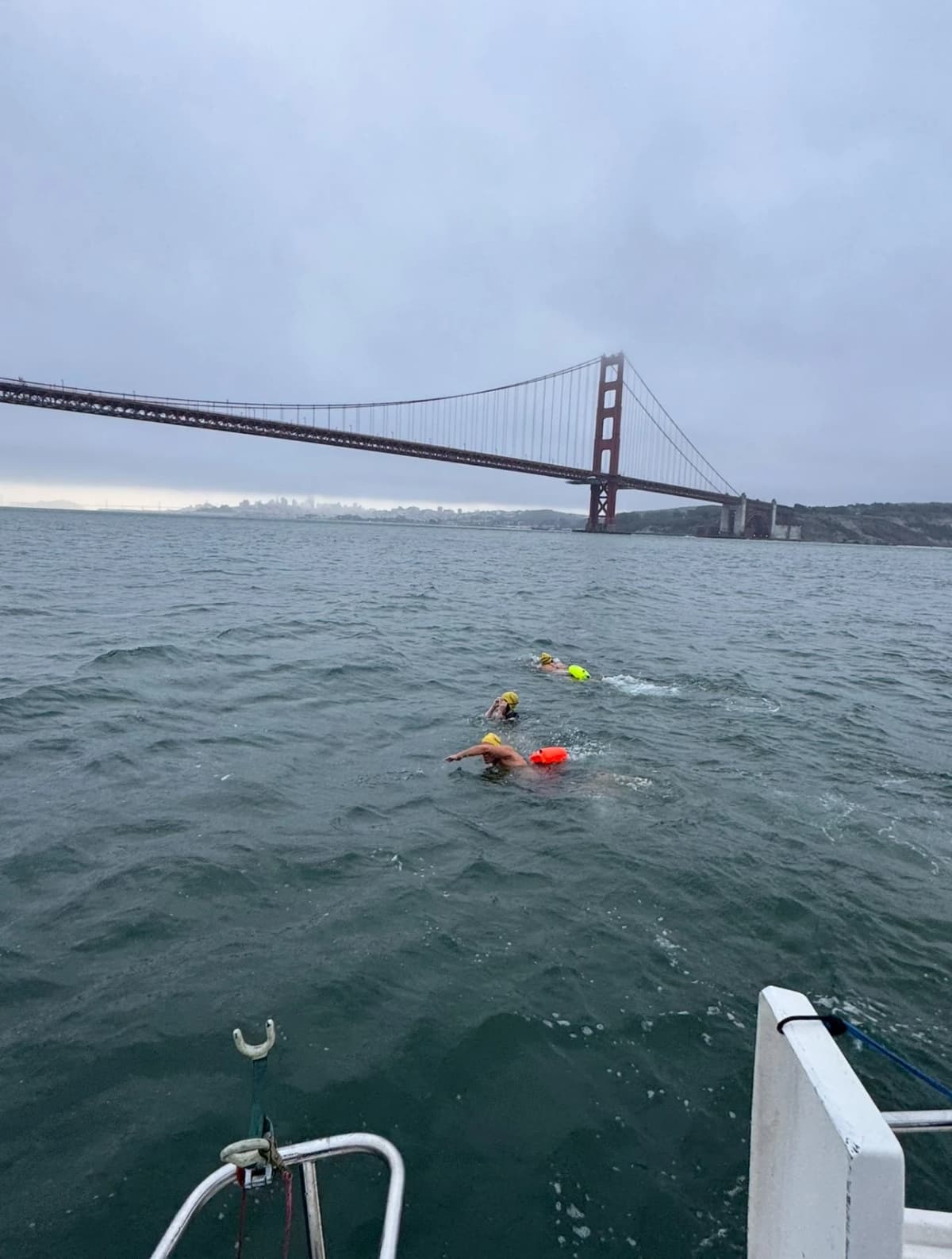
On a private escort, Miss Molly stays beside or behind you the whole way, never in front, so you can sight on the boat without it blocking your line. Captain Molly watches traffic on AIS and radar while keeping you in view. She holds a USCG Master license (100 GRT, Near Coastal) with a Radar Observer endorsement and is trained in First Aid and CPR.
When you’re choosing any escort, ask the captain how they keep the swimmer in sight while watching traffic, how they’ll tell you about a course change, and what happens if you fall behind. Equipment alone doesn’t answer those questions. The captain’s plan does.
Up to 6 people can be aboard, so a coach, an official observer or family can come along. A kayaker can join at extra cost. When you’re out of the water, Miss Molly has a heated cabin to warm up in and a private bathroom.
Are you ready for it?
Before she books a swim, Captain Molly asks two things. Have you swum open water in the Bay, or only in a pool? And are you experienced in cold water? Answer honestly in your booking notes. Neither answer rules you out, but they shape the plan.
Before you sign up, you should be able to:
- Cover the distance without a wall. Swim the full 1.9 miles in open water without stopping to rest.
- Sight without losing your stroke. Lift your eyes to a landmark and get back into rhythm in a stroke or two.
- Keep going in chop. Small waves break up your breathing, so train in open water that isn’t flat.
- Handle cold entry. Know how your body reacts in the first few minutes, and have a plan for it.
If you’re training for the Escape from Alcatraz Triathlon or Sharkfest, a private practice crossing lets you swim the water before race day, on your own schedule.
Weather calls and changes on the day
No fixed number decides whether a swim goes ahead. Captain Molly makes the call on the day, looking at fog and visibility, wind and chop, smoke and air quality during fire season, big-ship traffic in the channel and how the current is behaving. She may also end a swim partway if a swimmer falls well behind plan or the tide window is closing. An escort supports your crossing. It can’t promise you’ll finish it.
Swim day
- Meet at Hyde Street Harbor, 2951 Hyde St, near Fisherman’s Wharf. Text Captain Molly from the bench when you arrive, and don’t walk down to the boat on your own.
- Eat something familiar. A light meal you know sits well. Sip water instead of drinking a lot at once.
- Pack dry layers and a warm drink so they’re within reach the moment you climb out.
- Put your things in one bag with your name on it. It stays aboard while you swim.
After the swim, get out of your wet suit and into dry layers quickly, and move gently while you warm up. Tell the captain right away if you feel confused, clumsy or unusually cold. Those are signs of cold injury, and you shouldn’t wait them out.
Booking a private Alcatraz swim escort
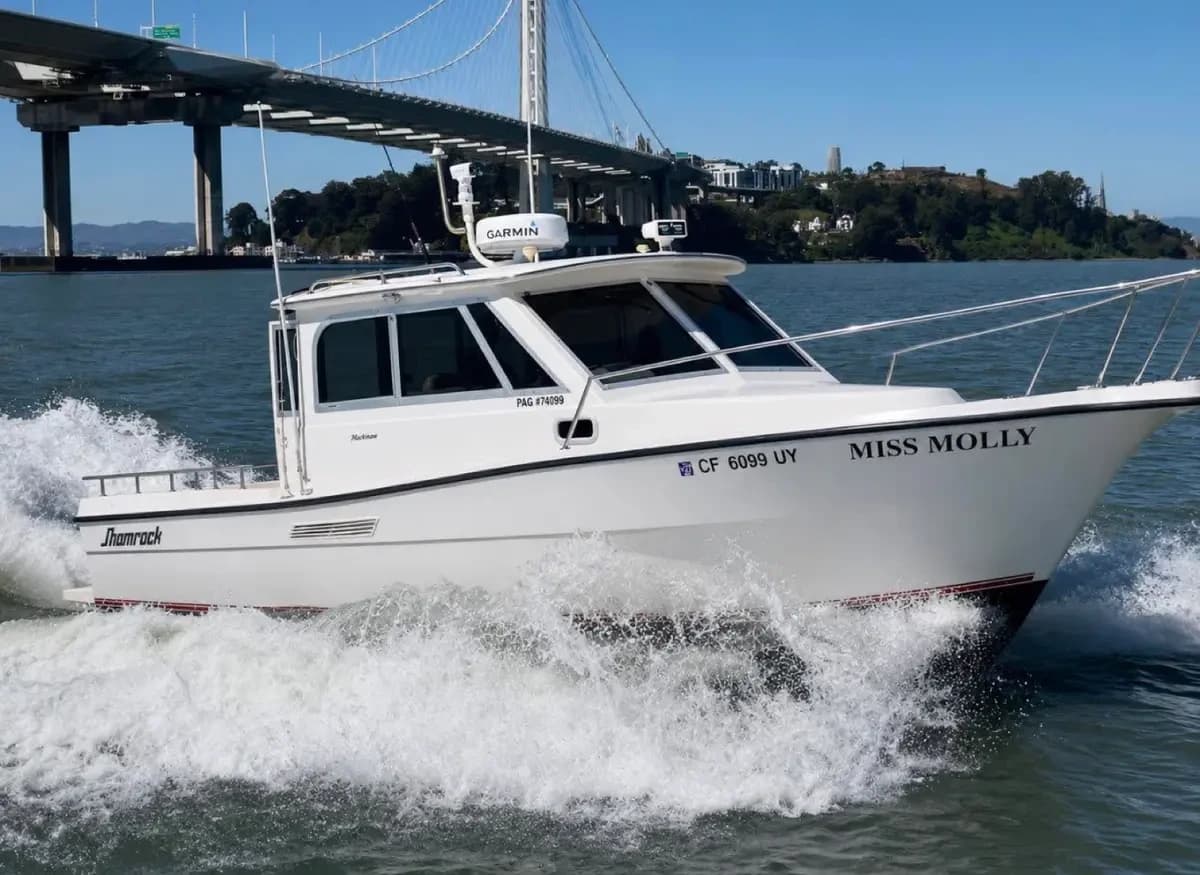
The Alcatraz swim escort is $550 per booking, for the boat and captain rather than per swimmer, with up to 6 aboard. You pay in full when you book, and you can cancel free up to 7 days before the swim. For Bridge to Bridge, Angel Island and longer training swims, see all swim escort trips. For water temperature by month and how a swim pilot works, read the open-water swim guide.
Frequently asked questions
How far is the Alcatraz swim?
About 1.5 miles in a straight line from Alcatraz to the St. Francis Yacht Club. Because the current pushes you sideways, most swimmers cover 1.7 to 1.9 miles.
How long does it take to swim from Alcatraz?
About an hour for most swimmers. A strong current or a slower pace can stretch it, which is why the jump time matters.
Can you swim from Alcatraz to San Francisco?
Yes. People do it in organized races and on private escorted swims. Swims start from a boat beside the island, and you need an escort boat because the route crosses the shipping channel.
How cold is the water for the Alcatraz swim?
San Francisco Bay averages about 52°F in January and about 61°F in September, according to NOAA. Cold shock is a risk at any of those temperatures.
Are there sharks around Alcatraz?
White sharks sometimes enter the Bay, but there’s no verified white shark attack on a swimmer inside the Bay on record. Cold water and ship traffic are the risks to plan for.
Do I need a wetsuit?
Not necessarily, but most swimmers wear one. Go without only if you already train regularly in cold open water.
Can my coach or family come on the boat?
Yes. Up to 6 people can be aboard, including a coach, an official observer or family.